- Does Every Role Require a DBS Check?
- Legal Requirement vs Employer Policy: The Critical Distinction
- Roles and Sectors With a Legal Requirement for a DBS Check
- Volunteers: Who Needs a DBS Check in the Voluntary Sector?
- Can an Employer Request a DBS Check for Any Role?
- Who Pays for a DBS Check?
- Now You Know a Check Is Required: Find Out Which Level Is Right for Your Role
- Apply for a DBS Check Through Checks.co.uk
- Frequently Asked Questions About Who Needs a DBS Check
Who Needs a DBS Check? Requirements by Role and Sector in England and Wales
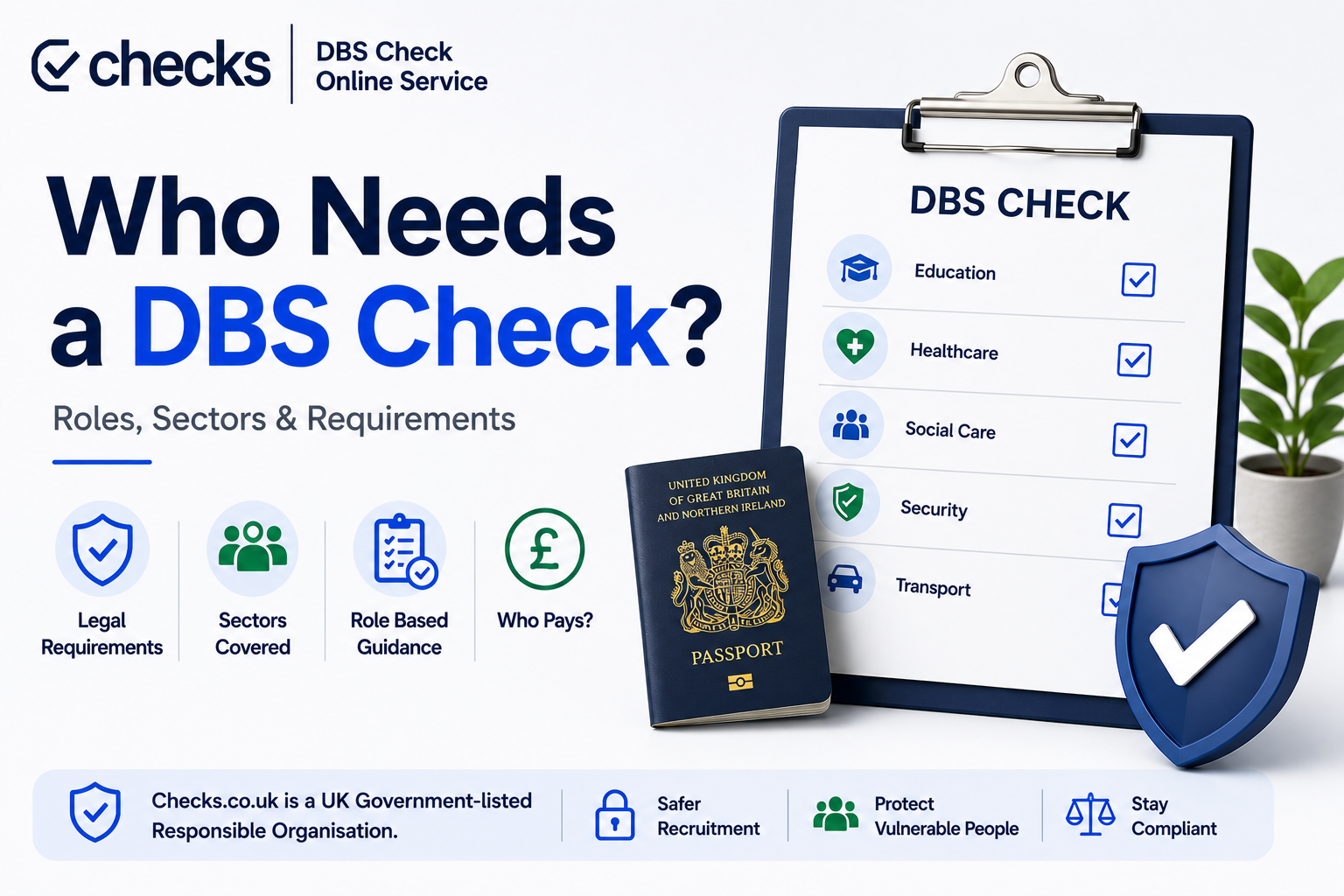
Not every role requires a DBS check. Whether one is needed depends on the nature of the work, the sector, and whether the requirement is a legal obligation or an employer policy decision.
Over 7.2 million DBS certificates were issued in England and Wales in 2024-25 (DBS Annual Report 2024-25, GOV.UK), but this does not mean every employer is legally required to carry one out.
Checks.co.uk is a UK Government-listed Responsible Organisation, authorised to process DBS applications across all check levels on behalf of employers and individuals.
Does Every Role Require a DBS Check?
No. A DBS check is not a universal employment requirement in England and Wales. The Rehabilitation of Offenders Act 1974 and the Police Act 1997 together determine when an employer is legally entitled to request a specific level of check.
For many roles, no legal requirement exists and whether a DBS check is conducted is entirely the employer’s decision.
Legal Requirement vs Employer Policy: The Critical Distinction
There are two distinct reasons a DBS check may be needed, and understanding the difference is essential for both employers and applicants.
- Legal requirement: the role is covered by specific legislation or regulatory guidance that mandates a DBS check, and failing to carry one out is a breach of a statutory obligation.
- Employer policy: no law requires a check, but the employer has decided to request one as part of their recruitment process, which is lawful provided they have a legitimate purpose.
Employers can only request a Standard or Enhanced DBS check for roles that are legally eligible under the Rehabilitation of Offenders Act 1974 (Exceptions) Order 1975. They cannot request a higher-level check simply because they want one.
Roles and Sectors With a Legal Requirement for a DBS Check
The following sectors have a statutory or regulatory requirement for a DBS check, with the level determined by the nature of the role.
Education: Teachers, Teaching Assistants, and School Staff
All staff working in maintained schools, academies, free schools, and independent schools must have a DBS check before starting work, as a statutory requirement under Keeping Children Safe in Education 2025 (KCSIE 2025).
The required level is an Enhanced DBS check with Barred Lists (Children’s) for anyone working in regulated activity, including teachers, teaching assistants, learning support assistants, and school governors.
Temporary and supply staff are included within this requirement and must be checked before they begin work.
Healthcare: NHS and Clinical Roles
All NHS staff in clinical roles involving direct patient contact must have a DBS check as a condition of employment, with regulated clinical roles including doctors, nurses, midwives, physiotherapists, and care assistants in clinical settings requiring an Enhanced DBS check, with a Barred Lists search where the role involves regulated activity.
The specific roles requiring each check level are set out in the NHS Employment Check Standards, which all NHS trusts are required to follow (NHS Employers).
Social Care and Adult Services
Care Quality Commission (CQC)-regulated providers of adult social care must conduct Enhanced DBS checks for all staff in roles involving regulated activity with vulnerable adults, including residential care workers, home care workers, and community support workers.
Under the Health and Social Care Act 2008 (Regulated Activities) Regulations 2014, employing a barred person in a regulated activity role is a criminal offence. Failure to meet DBS checking requirements may result in CQC registration action against the provider.
Childcare and Early Years
All childcare providers registered with Ofsted under the Early Years Register and Childcare Register must have DBS checks for all staff and regular volunteers, with an Enhanced DBS check with Barred Lists (Children’s) required for anyone in regulated activity.
This applies to nurseries, childminders, after-school clubs, and holiday playschemes operating under Ofsted registration requirements.
Security Industry Licence Holders
Individuals applying for or renewing a Security Industry Authority (SIA) licence must pass a criminal record check as part of the licensing process, with a Standard DBS check required for door supervisors, CCTV operators, security guards, and close protection officers. Without a satisfactory DBS result, an SIA licence cannot be granted or renewed (SIA licensing requirements).
Taxi and Private Hire Drivers
All taxi and private hire vehicle licence applicants in England and Wales must undergo an Enhanced DBS check as a condition of their driving licence, administered by local councils under the Local Government (Miscellaneous Provisions) Act 1976.
Because taxi and private hire drivers have unsupervised access to members of the public, including potentially vulnerable passengers, Enhanced checks are standard across licensing authorities.
Legal and Financial Services
Roles regulated by the Financial Conduct Authority (FCA) or the Solicitors Regulation Authority (SRA) often require a Standard DBS check as part of pre-employment vetting, covering solicitors, barristers, financial advisers, accountants in regulated roles, and insurance brokers.
These checks are required because such roles involve positions of trust and, in some cases, access to client funds or sensitive personal data (FCA and SRA vetting requirements).
Volunteers: Who Needs a DBS Check in the Voluntary Sector?
Not all volunteers require a DBS check, but those carrying out regulated activity do.
Volunteers in Regulated Activity With Children or Vulnerable Adults
Volunteers who carry out regulated activity, defined as unsupervised direct contact with children or vulnerable adults on a regular basis under the Safeguarding Vulnerable Groups Act 2006, require an Enhanced DBS check, usually with a Barred Lists search.
This requirement applies regardless of whether the role is paid or unpaid. Common examples of volunteers in regulated activity include:
- youth group leaders and children’s sports coaches,
- volunteers in care homes or hospitals providing direct support,
- Scouts and Girlguiding leaders, and
- mentors working alone with children.
Faith and Community Settings
Churches, mosques, synagogues, and other faith organisations running activities for children or vulnerable adults, such as youth clubs, Sunday school classes, or welfare support, are subject to the same safeguarding rules as any other organisation.
Leaders and volunteers running these activities in a regulated activity capacity require an Enhanced DBS check with a Barred Lists search (DBS safeguarding guidance). Faith organisations are not exempt from DBS requirements.
Roles That Do Not Require a DBS Check
No statutory requirement for a DBS check exists for a significant number of common employment categories, and employers in these sectors are not legally obliged to conduct one. This is not a gap in the law.
It reflects the fact that DBS checks are designed for roles involving safeguarding responsibilities or positions of trust in regulated professions, not general employment. The following categories of role have no statutory DBS requirement:
- most private sector roles without safeguarding responsibilities,
- retail and hospitality positions,
- office and administrative roles in non-regulated organisations,
- manufacturing, logistics, and construction, and
- most technology and IT roles.
Employers in these sectors may still choose to request a Basic DBS check as an internal policy decision, but this is employer discretion and not a legal obligation.
Can an Employer Request a DBS Check for Any Role?
The answer depends on the check level. For a Basic DBS check, any employer can request one for any role, but must have a lawful basis for processing the information under UK GDPR and must not use it to discriminate unlawfully under the Equality Act 2010.
For Standard and Enhanced DBS checks, the employer can only request these levels for roles that are legally eligible under the Rehabilitation of Offenders Act 1974 (Exceptions) Order 1975, and requesting a higher-level check for an ineligible role is unlawful.
Employers who are unsure whether their role qualifies should consult the DBS eligibility guidance on GOV.UK before making a request.
Who Pays for a DBS Check?
The cost responsibility depends on the check level and how the application is made:
- Basic DBS (self-applied): the individual pays £21.50 directly to the DBS.
- Basic DBS (employer-requested): the employer typically pays, though there is no legal requirement for them to do so.
- Standard and Enhanced: the employer or Responsible Organisation pays the DBS fee.
- Volunteer Enhanced checks: the DBS waives the £49.50 fee for eligible volunteers — no government fee is charged.
Now You Know a Check Is Required: Find Out Which Level Is Right for Your Role
Knowing that a DBS check is required is the first step. The next is identifying the correct level for the role. For a full breakdown of which check level applies, visit the which DBS check do I need guide.
Apply for a DBS Check Through Checks.co.uk
Checks.co.uk is a UK Government-listed Responsible Organisation, registered in England and Wales (Company Number 15076484) and registered with the Information Commissioner’s Office (ICO Reference XB691512), authorised to process Basic, Standard, Enhanced, and Enhanced with Barred Lists DBS applications on behalf of employers and individuals.
To apply, choose your check level, verify your identity, and complete the online application.
Frequently Asked Questions About Who Needs a DBS Check
Is a DBS check legally required for all jobs?
No. A DBS check is not a legal requirement for all jobs in England and Wales. Legal requirements apply to specific sectors and roles, primarily those involving work with children, vulnerable adults, or regulated professions such as law, finance, and security. For most private sector roles, including retail, administration, IT, and logistics, no law requires a DBS check, though employers may request a Basic DBS as a policy decision.
Do volunteers need a DBS check?
It depends on the nature of the volunteering role. Volunteers who carry out regulated activity, meaning unsupervised work with children or vulnerable adults on a regular basis, require an Enhanced DBS check, typically with a Barred Lists search. Volunteers in non-regulated roles do not have a legal requirement. Eligible volunteers pay no fee for a Standard or Enhanced DBS check, as the government waives the DBS charge for voluntary roles.
Who needs a DBS check in a church or faith setting?
Individuals leading or volunteering in activities that involve regulated activity with children or vulnerable adults in faith settings need an Enhanced DBS check. This applies regardless of whether the role is paid or unpaid, and faith organisations are not exempt from safeguarding requirements. A Sunday school teacher or youth group leader in a church, mosque, or synagogue is held to the same standard as a teacher in a school.
Do self-employed workers need a DBS check?
It depends on the work. Most self-employed individuals only have access to a Basic DBS check, which they can apply for themselves. From 21 January 2026, self-employed people working in regulated activity with children or vulnerable adults can apply for an Enhanced DBS check independently through a registered platform. A private tutor working alone with children, for example, should have an Enhanced DBS check under the new rules.
Who pays for a DBS check: the employer or the employee?
It depends on the check type and how it is applied for. Individuals applying for their own Basic DBS check pay the £21.50 fee directly. When an employer requests a Standard or Enhanced check, they are responsible for the DBS fee, though there is no law requiring this. Eligible volunteers pay no DBS fee for Standard or Enhanced checks. Some employers pass the Basic DBS cost to the applicant, but this is a matter of internal policy.
Can an employer refuse to hire someone without a DBS check?
Yes, provided the role is one where a DBS check is lawfully permitted. For roles legally eligible for a Standard or Enhanced check, employers can make the check a condition of employment. For Basic DBS checks, employers can make them a condition of hire for any role. Employers must apply DBS results fairly, consider the relevance of any disclosed information, and comply with the Equality Act 2010 and the Rehabilitation of Offenders Act 1974.
Does a DBS check need to be renewed, and does that affect who needs one?
The requirement for a DBS check is about whether the role needs one at all. Renewal is a separate question. A certificate does not expire, but employers set renewal policies, typically every one to three years, to ensure information remains current. Full information on DBS certificate validity and renewal is available on our dedicated renewal guide.