- The Core Rule: You Cannot Request a Higher Level Than Your Role Qualifies For
- The Three Criteria That Determine the Correct DBS Check Level
- DBS Check Level Decision Table
- When a Basic DBS Check Is the Right Level
- When a Standard DBS Check Is the Right Level
- When an Enhanced DBS Check Is the Right Level
- How to Confirm Your Role's Eligibility Before Applying
- Apply for the Right DBS Check Through Checks.co.uk
- Frequently Asked Questions About Choosing the Right DBS Check
Which DBS Check Do I Need? A Decision Guide for England and Wales
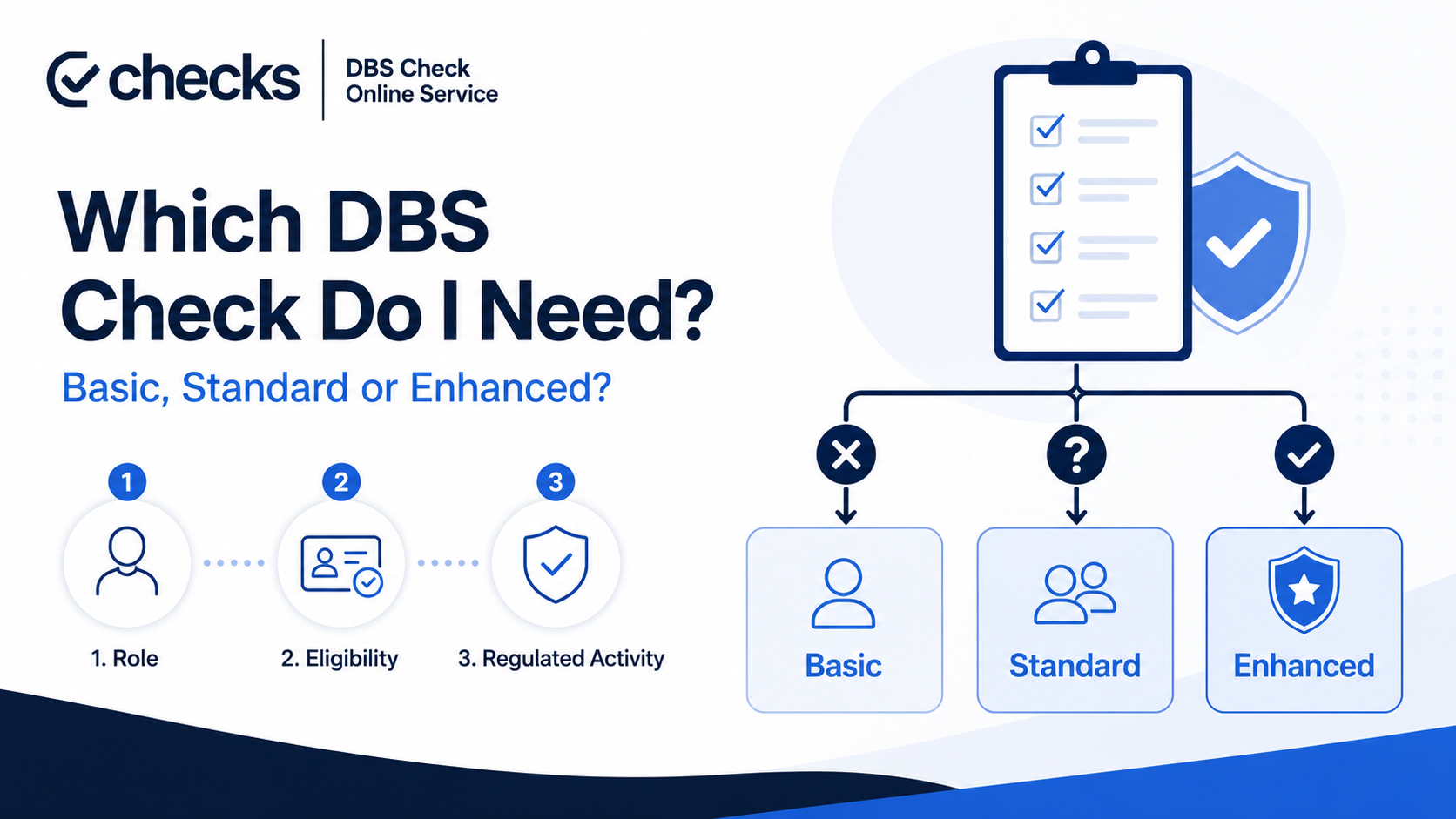
This guide helps employers, HR professionals, and self-employed individuals identify the correct DBS check level for a specific role. The answer depends on three legal criteria, not personal preference, and requesting the wrong level can result in a rejected application or a breach of safeguarding obligations.
If you are unsure whether a DBS check is required at all for your role, see our guide on who needs a DBS check first.
Checks.co.uk is a UK Government-listed Responsible Organisation, authorised to process all four DBS check levels on behalf of employers and individuals.
The Core Rule: You Cannot Request a Higher Level Than Your Role Qualifies For
The level of DBS check an employer can request is determined by legal eligibility, not by preference, and requesting a higher level than the role qualifies for is unlawful and will result in the DBS rejecting the application.
Some employers request the highest available level to be safe. This is not permitted under the Rehabilitation of Offenders Act 1974 (Exceptions) Order 1975 and the Police Act 1997, which together define the statutory eligibility framework. The check level must match the role:
- Basic DBS: open to any individual or employer for any role, with no eligibility test.
- Standard DBS: can only be requested for roles listed on the Rehabilitation of Offenders Act 1974 (Exceptions) Order 1975.
- Enhanced DBS: can only be requested for roles meeting the same Exceptions Order criteria plus the relevant Police Act 1997 regulations.
The Three Criteria That Determine the Correct DBS Check Level
Three questions, applied in sequence, determine the correct DBS check level for any role.
Question 1: Does the Role Have Any Safeguarding, Regulatory, or Trust Obligation?
If the role involves no regulated contact with vulnerable groups, no statutory trust requirement, and no professional licence requirement, only a Basic DBS check is available.
The employer can still choose to request a Basic check for general employment assurance. If the answer is yes, proceed to Question 2.
Question 2: Does the Role Appear on the Exceptions Order?
The Rehabilitation of Offenders Act 1974 (Exceptions) Order 1975 lists specific roles that are legally exempt from normal spent conviction rules and are therefore eligible for Standard or Enhanced DBS checks.
Typical categories on the Exceptions Order include legal professionals, financial advisers, healthcare professionals regulated under the Health and Care Professions Council (HCPC), security industry workers, and roles involving children or vulnerable adults.
If the role appears on the Exceptions Order, proceed to Question 3. If it does not, only a Basic check is available.
Question 3: Does the Role Involve Regulated Activity?
Regulated activity is unsupervised work with children or vulnerable adults on a regular basis, as defined by the Safeguarding Vulnerable Groups Act 2006, and roles involving regulated activity are eligible for an Enhanced DBS check with a mandatory Barred Lists search.
Roles that appear on the Exceptions Order but do not involve regulated activity, such as a financial adviser or security guard, are eligible for a Standard check but not an Enhanced one.
The employer must determine whether the specific role meets the regulated activity test before deciding between Standard and Enhanced.
DBS Check Level Decision Table
The table below maps role characteristics to the correct DBS check level, based on the criteria set out in the Rehabilitation of Offenders Act 1974 (Exceptions) Order 1975 and the Safeguarding Vulnerable Groups Act 2006.
| Role Characteristic | Eligible Level | Common Examples |
|---|---|---|
| No safeguarding or trust obligation | Basic only | Retail, administration, IT, logistics |
| Position of trust (Exceptions Order, no regulated activity) | Standard | Solicitors, accountants, security guards, financial advisers |
| Regulated activity with children or vulnerable adults | Enhanced | Teachers, social workers, childminders, care workers |
| Regulated activity where barred list search is mandatory | Enhanced with Barred Lists | Teachers in regulated activity, nurses in regulated activity, foster carers |
When a Basic DBS Check Is the Right Level
A Basic DBS check is the default level for roles without a specific safeguarding or regulatory requirement and is the only DBS check level that an individual can apply for themselves. Any employer can also request a Basic check for any role, making it the most accessible and widely used level across general employment.
Roles That Typically Use a Basic DBS Check
The following roles typically use a Basic DBS check, with employers requesting one as an internal policy decision rather than a legal requirement in most cases:
- domestic cleaners and housekeepers,
- delivery drivers and couriers,
- estate agents and letting agents,
- retail supervisors and shop floor managers,
- administrative roles in non-regulated organisations,
- IT technicians and support staff,
- security guards in non-SIA roles,
- childcare assistants working in supervised settings, and
- general volunteers in non-regulated activity.
Personal Licence Applications: A Specific Use Case
A personal licence under the Licensing Act 2003 is required by any individual who wishes to sell or authorise the sale of alcohol in England and Wales, and applicants must provide a Basic DBS check to the local licensing authority as part of the application process (Licensing Act 2003; Home Office personal licence guidance).
The Basic DBS check is the specified level for this purpose. The application does not require a Standard or Enhanced check, and providing a higher-level certificate does not satisfy the requirement.
Applicants should apply for a Basic DBS check before submitting their personal licence application to the local council.
When a Standard DBS Check Is the Right Level
A Standard DBS check is the appropriate level for positions of trust where the role is listed in the Rehabilitation of Offenders Act 1974 (Exceptions) Order 1975 but does not involve regulated activity with children or vulnerable adults.
It is not available to individuals applying for themselves and must be requested by an employer or Responsible Organisation.
Roles That Typically Require a Standard DBS Check
The following roles typically require a Standard DBS check, though some may require an Enhanced check if regulated activity is also involved. The employer must verify using the Exceptions Order:
- solicitors and legal professionals,
- accountants and financial advisers,
- actuaries,
- insurance brokers,
- security industry workers holding an SIA licence,
- pharmacists in non-clinical, non-regulated roles,
- some NHS non-clinical roles,
- certain roles in the prison and probation service,
- estate agents in regulated roles, and
- dental practitioners in specific non-regulated roles.
When an Enhanced DBS Check Is the Right Level
An Enhanced DBS check is required for roles involving regulated activity with children or vulnerable adults, and carries stricter eligibility requirements than a Standard check.
The Barred Lists question is a separate determination within the Enhanced level and is covered below.
Does the Role Require a Barred List Search?
An Enhanced DBS check does not automatically include a Barred Lists search.
The search is only added when the role involves regulated activity as defined by the Safeguarding Vulnerable Groups Act 2006. Where the role does involve regulated activity, an Enhanced check with a Barred Lists search is mandatory, and it is a criminal offence to knowingly employ a barred person in regulated activity.
Where the role involves unsupervised work near children or vulnerable adults but does not meet the regulated activity definition, a plain Enhanced check may be sufficient, and the employer must determine whether the specific role meets the regulated activity test before applying.
Roles That Typically Require an Enhanced DBS Check
The following roles typically require an Enhanced DBS check, with whether a Barred Lists search is also needed depending on whether the specific role involves regulated activity:
- teachers and teaching assistants,
- headteachers and school governors,
- social workers,
- nursery and childcare practitioners,
- care home workers,
- home care workers,
- foster carers and adoption applicants,
- youth workers and sports coaches working with children,
- hospital nurses and doctors in regulated clinical roles,
- religious leaders working in regulated activity, and
- taxi and private hire drivers (Enhanced required for PHV and PCO licence applications).
Self-Employed Workers: Applying for Standard or Enhanced From January 2026
From 21 January 2026, self-employed individuals working in regulated activity with children or vulnerable adults can apply for Standard and Enhanced DBS checks through a registered platform acting as the countersigning organisation, having previously been limited to Basic checks only.
This change affects private tutors, self-employed carers, nannies, childminders, sports coaches, music teachers, and any self-employed individual in a role involving regulated activity.
The eligibility criteria are the same as for employed individuals: the role must qualify under the Exceptions Order and, for Enhanced checks, must involve regulated activity.
Checks.co.uk is a Responsible Organisation authorised to process these applications.
How to Confirm Your Role’s Eligibility Before Applying
For any employer or individual still uncertain after applying the three criteria, the DBS publishes detailed eligibility guidance by sector and role type on GOV.UK, which should be consulted before an application is submitted.
Responsible Organisations, including Checks.co.uk, can also advise on eligibility before an application is made. Visit the apply page to get started or to request guidance on the correct check level.
Apply for the Right DBS Check Through Checks.co.uk
Checks.co.uk is a UK Government-listed Responsible Organisation, registered in England and Wales (Company Number 15076484) and registered with the Information Commissioner’s Office (ICO Reference XB691512), authorised to process all four DBS check levels.
If you are unsure which level applies to your role, use our Check Type Selector to find the right level before you apply.
Frequently Asked Questions About Choosing the Right DBS Check
Can I choose any level of DBS check I want?
No. The level of DBS check you can request is determined by the nature of the role and its legal eligibility, not by personal preference. A Basic DBS check is available for any role. Standard and Enhanced checks can only be requested for roles meeting the criteria set out in the Rehabilitation of Offenders Act 1974 (Exceptions) Order 1975. Requesting a higher-level check for an ineligible role is unlawful and the application will be rejected.
Which DBS check do I need as a nurse?
Most clinical nursing roles require an Enhanced DBS check, often with a Barred Lists search, because they involve regulated activity with vulnerable adults or children. The exact level depends on the specific role and the degree of unsupervised patient contact. Nurses in non-clinical or administrative roles may only require a Standard check. The employing NHS trust determines the required level based on the role description and NHS Employment Check Standards.
Which DBS check do I need to work with children?
Roles involving regulated, unsupervised work with children, such as teaching, childcare, youth work, or sports coaching, require an Enhanced DBS check. Where the role involves regulated activity, a Barred Lists search for the Children’s Barred List is also required. This is mandatory for most education and childcare positions. Basic and Standard checks are not sufficient for regulated activity roles with children.
Which DBS check is required for a taxi or PCO licence?
Most councils and Transport for London (TfL) require an Enhanced DBS check for taxi and private hire vehicle licence applications. This is a licensing requirement, not a direct DBS rule. The specific requirement is confirmed by the local licensing authority processing the licence application.
Which DBS check do I need for a personal licence?
A Basic DBS check is required when applying for a personal licence under the Licensing Act 2003. The Basic check is the specified level for this application and must be provided to the local licensing authority as part of the personal licence application. A Standard or Enhanced check is not required or appropriate for this purpose.
Which law created DBS checks?
The Disclosure and Barring Service was established by the Protection of Freedoms Act 2012, which merged the Criminal Records Bureau (CRB) and the Independent Safeguarding Authority (ISA). The checks themselves are governed by the Police Act 1997 for Standard and Enhanced checks, and the Rehabilitation of Offenders Act 1974. The DBS operates under the Home Office as a non-departmental public body.
As a self-employed worker, which DBS check can I get?
From 21 January 2026, self-employed individuals can apply for Standard and Enhanced DBS checks for roles that meet the legal eligibility criteria. Previously, self-employed people could only obtain a Basic DBS check through GOV.UK. The new route requires applying through a registered platform or Responsible Organisation that acts as the countersigning body. Basic DBS checks remain available to self-employed individuals directly through the DBS online service.