- What Does a Basic DBS Check Show?
- What Does a Standard DBS Check Show?
- What Does an Enhanced DBS Check Show?
- What Does a DBS Check Not Show? Common Misconceptions
- What Happens to Juvenile Convictions and Cautions When You Turn 18?
- Can You Dispute What Appears on a DBS Certificate?
- Apply for a DBS Check Through Checks.co.uk
- Frequently Asked Questions About DBS Check Disclosures
What Does a DBS Check Show? Basic, Standard & Enhanced Explained
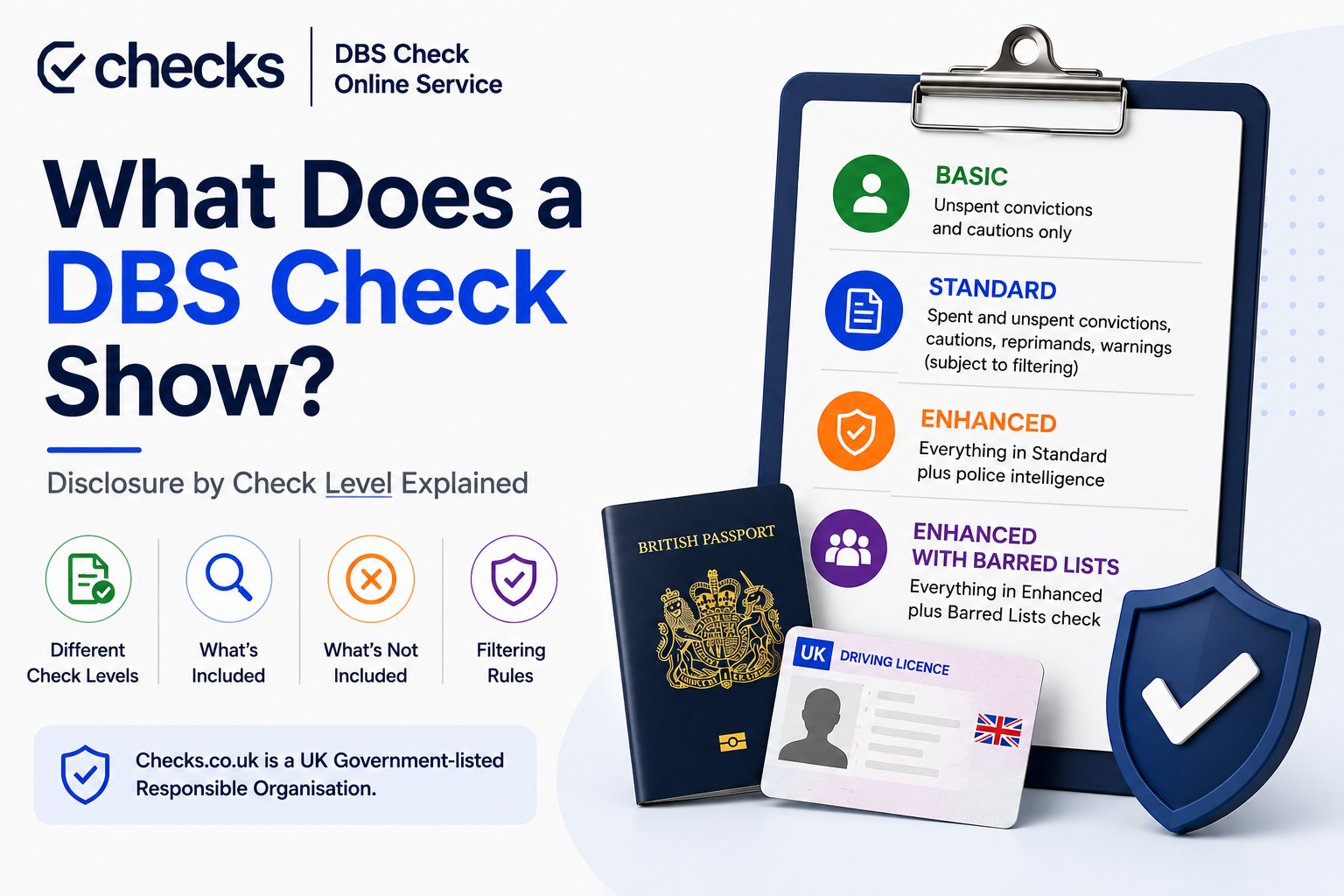
What a DBS check discloses depends entirely on the check level. A Basic check shows the least information; an Enhanced DBS check with Barred Lists shows the most comprehensive picture available. In 2024-25, the Disclosure and Barring Service issued 7,272,217 certificates (DBS Annual Report 2024-25, GOV.UK). Whether you are an applicant wanting to know what your employer will see, or an employer reviewing what the certificate reveals, the level requested determines everything.
Checks.co.uk is a UK Government-listed Responsible Organisation, authorised to process DBS applications across all four check levels.
What Does a Basic DBS Check Show?
The Basic DBS check is the most limited in terms of disclosure and is the only level that an individual can self-apply for. Full details are on the Basic DBS Check page.
What Information Is on a Basic DBS Certificate
A Basic DBS certificate shows two things only: unspent convictions and conditional cautions, both drawn from the Police National Computer (PNC) (Police Act 1997; Rehabilitation of Offenders Act 1974). A conditional caution is an out-of-court disposal with conditions attached.
Once conditions are met, the caution is discharged. An unspent conviction is a criminal conviction still within its rehabilitation period under the Rehabilitation of Offenders Act 1974.
Nothing else appears on a Basic certificate: no spent convictions, no police intelligence, and no cautions other than conditional cautions.
What a Basic DBS Check Does Not Include
Basic DBS certificates do not show spent convictions, locally held police intelligence, soft information held by local forces, or any barred list information.
They do not show financial records, employment history, or any non-criminal information. For roles where those disclosures are required, a Standard or Enhanced check must be used, subject to eligibility.
See our guide on which DBS check you need for more information.
What Does a Standard DBS Check Show?
Standard DBS checks disclose a fuller criminal record history than Basic checks and are subject to DBS filtering rules that affect which convictions appear. Full details are on the Standard DBS Check page.
What Information Is on a Standard DBS Certificate
A Standard DBS certificate shows both spent and unspent convictions, cautions, reprimands, and final warnings held on the Police National Computer, subject to DBS filtering rules (gov.uk DBS filtering guidance, updated October 2023).
Unlike a Basic check, spent convictions also appear unless they have been filtered under the current rules.
Reprimands and final warnings are legacy youth disposals that are no longer issued, but they can still appear where they remain on a person’s record.
Youth cautions, warnings, and reprimands are not automatically disclosed on Standard or Enhanced certificates following the November 2020 filtering update.
Filtering Rules: When Convictions May Not Appear on a Standard Check
Not all spent convictions and cautions appear on Standard or Enhanced certificates. The DBS applies filtering rules to identify which records are removed from the certificate.
An adult conviction is filtered, meaning it is not disclosed, if all four criteria are met: it is spent, 11 years have passed since the date of conviction, it did not result in a custodial sentence, and it is not on the list of specified offences.
An adult caution is filtered if 6 years have passed and it is not a specified offence (gov.uk DBS filtering guidance, updated 28 October 2023).
Filtered records are not deleted. They remain on the Police National Computer but are not shown on the certificate.
One further complication is the drag-on effect: if one associated conviction or court order is unspent, such as an indefinite restraining order, it can cause other spent convictions linked to the same case to be disclosed alongside it.
See our guide on spent and unspent convictions for more detail.
What Does an Enhanced DBS Check Show?
Enhanced DBS checks introduce a disclosure element that does not appear on Basic or Standard certificates: locally held police intelligence.
Full details are on the Enhanced DBS Check page.
What Information Is on an Enhanced DBS Certificate
An Enhanced DBS certificate includes everything on a Standard certificate, including spent and unspent convictions, cautions, reprimands, and final warnings, subject to filtering, plus any information held by local police forces that the chief officer considers relevant to the role.
This locally held intelligence is unique to the Enhanced level and does not appear on Basic or Standard checks. Whether additional information is returned depends entirely on the chief officer’s assessment.
Not all Enhanced certificates contain police intelligence beyond the PNC, but the search is always conducted.
Police Intelligence on an Enhanced DBS Check: What It Means
Most competitor pages describe this as ‘locally held police information’ without explaining what that means in practice. The chief officer of each local police force reviews their own records for information relevant to the role.
This can include intelligence from investigations that did not result in a charge, information from voluntary police interviews, and details of incidents on record that never led to a prosecution.
What is disclosed, and whether it is disclosed at all, is entirely at the chief officer’s discretion (gov.uk, Applicant’s introduction to the decision-making process for enhanced criminal record checks, DBS, March 2014).
The consequence is that an Enhanced certificate can reveal information about an applicant that never appeared in any court. An applicant who believes disclosed police intelligence is inaccurate or should not have been included can make representations to the DBS.
Enhanced DBS with Barred Lists: What the Barred List Search Adds
An Enhanced check with Barred Lists adds a search of the Children’s Barred List, the Adults’ Barred List, or both. The result confirms whether the applicant is barred from working in regulated activity with children, adults, or both.
As of March 2025, 91,015 people were on the Children’s Barred List and 69,900 were on the Adults’ Barred List (DBS Annual Report 2024-25, GOV.UK).
A barred list result is recorded as a separate item on the certificate and does not alter or affect the criminal record disclosure.
What Does a DBS Check Not Show? Common Misconceptions
No competitor page covering this query has a section on what DBS checks do not reveal. The keyword data confirms genuine confusion across several common misconceptions. Each is addressed directly below.
Internet History, Social Media, and Digital Activity
A DBS check has no access to a person’s internet browsing history, social media accounts, email, messaging apps, or any other digital activity. DBS checks search criminal record databases maintained by the police.
They have no connection to any digital or online data. If an applicant has been cautioned, charged, or convicted in connection with online activity, such as sharing illegal content, that criminal record entry would appear on the relevant certificate. The digital activity itself does not.
Family Members’ and Relatives’ Criminal Records
A DBS check discloses only the criminal record of the individual named on the application.
The convictions, cautions, or police records of relatives, parents, siblings, partners, or anyone else connected to the applicant are not disclosed on a DBS certificate under any circumstances.
Family relationships have no bearing on DBS disclosure.
Overseas Criminal Records
A DBS check searches UK databases only. Criminal records held by overseas governments or law enforcement agencies are not accessible through the DBS process.
If an applicant has lived or worked outside the UK and has a criminal record abroad, that record will not appear on a DBS certificate.
Employers with safeguarding concerns about overseas applicants should request a criminal record check from the relevant country or an ACRO Police Certificate for UK nationals with overseas history (gov.uk guidance on overseas criminal record checks).
Civil, Financial, and Employment Records
DBS checks do not show civil court judgements, County Court Judgements (CCJs), bankruptcy orders, Individual Voluntary Arrangements (IVAs), employment history, academic qualifications, or any information held by HMRC.
These records exist in separate systems and are not part of any DBS database. Employers requiring financial or employment verification must arrange those checks separately.
What Happens to Juvenile Convictions and Cautions When You Turn 18?
Turning 18 does not automatically remove juvenile criminal records, and this is not addressed by any competitor page covering the ‘what does a DBS check show’ query.
A youth conviction may still be disclosed on a Standard or Enhanced DBS certificate if it is unspent, for a specified offence, or resulted in a custodial sentence, regardless of the applicant’s current age.
Under filtering rules, a youth conviction is filtered after 5.5 years if it is spent, did not result in a custodial sentence, and is not a specified offence.
Youth cautions, warnings, and reprimands, with the exception of youth conditional cautions, are no longer automatically disclosed on Standard and Enhanced certificates following the November 2020 filtering update (gov.uk DBS filtering guidance, November 2020 and October 2023 updates).
Can You Dispute What Appears on a DBS Certificate?
An applicant who believes their DBS certificate contains inaccurate information, or information that should have been filtered, can dispute the disclosure through the DBS.
For information drawn from the Police National Computer: the applicant should contact the DBS in writing with reasons and supporting evidence.
For locally held police intelligence on an Enhanced certificate: the applicant should contact the issuing police force and make representations through the DBS disclosure representations process.
The DBS has a formal review process for disputed certificates (DBS disclosure representations guidance, GOV.UK).
Apply for a DBS Check Through Checks.co.uk
Checks.co.uk is a UK Government-listed Responsible Organisation, registered in England and Wales (Company Number 15076484) and registered with the Information Commissioner’s Office (ICO Reference XB691512).
To apply, choose your check level, verify your identity, and complete the online application.
Frequently Asked Questions About DBS Check Disclosures
Does a DBS check show internet history?
No. A DBS check has no access to internet browsing history, social media profiles, email accounts, or any digital activity. DBS checks search criminal record databases held by the police, which are entirely separate from any online data. The only internet-related information that could appear on a DBS certificate is a criminal conviction arising from illegal online conduct, such as a conviction for distributing illegal content.
Does a DBS check show family members’ criminal records?
No. A DBS check discloses only the criminal record of the individual named on the application. The convictions, cautions, or police records of relatives, parents, siblings, partners, or anyone else connected to the applicant are not disclosed. Family relationships have no bearing on DBS disclosure under any circumstances.
Does a DBS check show spent convictions?
It depends on the check level. A Basic DBS check shows unspent convictions only. Spent convictions do not appear. A Standard or Enhanced DBS check can include spent convictions, but many are removed under DBS filtering rules. A spent conviction may still appear on a Standard or Enhanced certificate if it is for a specified offence, resulted in a custodial sentence, or the filtering time period has not elapsed.
What does an Enhanced DBS check show that Standard does not?
An Enhanced DBS check includes everything on a Standard certificate plus any locally held police intelligence that the chief officer of each relevant police force considers relevant to the role. This can include non-conviction information, such as records from investigations that did not result in a charge. The chief officer decides what to disclose, and applicants can make representations if they believe disclosed information is inaccurate or disproportionate.
Do juvenile convictions disappear from a DBS check when you turn 18?
Not automatically. Turning 18 does not remove juvenile records. A youth conviction may still appear on a Standard or Enhanced DBS certificate if it is unspent, for a specified offence, or resulted in a custodial sentence. Youth convictions that are spent, did not result in a custodial sentence, and are not specified offences are filtered after 5.5 years. Youth cautions, warnings, and reprimands are no longer automatically disclosed on Standard or Enhanced checks following the November 2020 filtering update.
What is the DBS filtering rule and how does it affect disclosure?
DBS filtering is the process that removes certain old or minor convictions and cautions from Standard and Enhanced certificates. An adult conviction is filtered if it is spent, 11 years have passed, it did not result in a custodial sentence, and it is not a specified offence. An adult caution is filtered after 6 years if not for a specified offence. Filtered records remain on the Police National Computer but are not shown on the DBS certificate. All convictions resulting in a custodial sentence are always disclosed.
Can an employer see my DBS certificate without my permission?
No. DBS certificates are issued to the applicant directly and employers cannot access them without the applicant’s consent. For Standard and Enhanced checks, the employer must have made the application and the applicant provides identity documents, so consent is implicit in the process. For Basic checks, the applicant receives the certificate and shares it voluntarily. An employer carrying out a DBS Update Service status check must also have the applicant’s explicit consent to do so.
What does a DBS check not show?
A DBS check does not show: internet browsing history or social media activity, family members’ criminal records, overseas criminal convictions (foreign records are not accessible through the DBS), civil court judgements or financial records such as bankruptcy or CCJs, employment history or qualifications, medical records, or allegations that did not result in a charge (except on Enhanced checks where the chief officer may include relevant police intelligence at their discretion).