- There Are Four Types of DBS checks, Not Three
- The Four DBS Check Levels at a Glance
- Basic DBS Check
- Standard DBS Check
- Enhanced DBS Check
- Enhanced DBS Check with Barred Lists
- What Happens If the Wrong Type of DBS Check Is Requested?
- Which Type of DBS Check Do You Need?
- Apply for the Right DBS Check Through Checks.co.uk
- Frequently Asked Questions About Types of DBS Check
Types of DBS Check: All Four Levels Explained for England and Wales
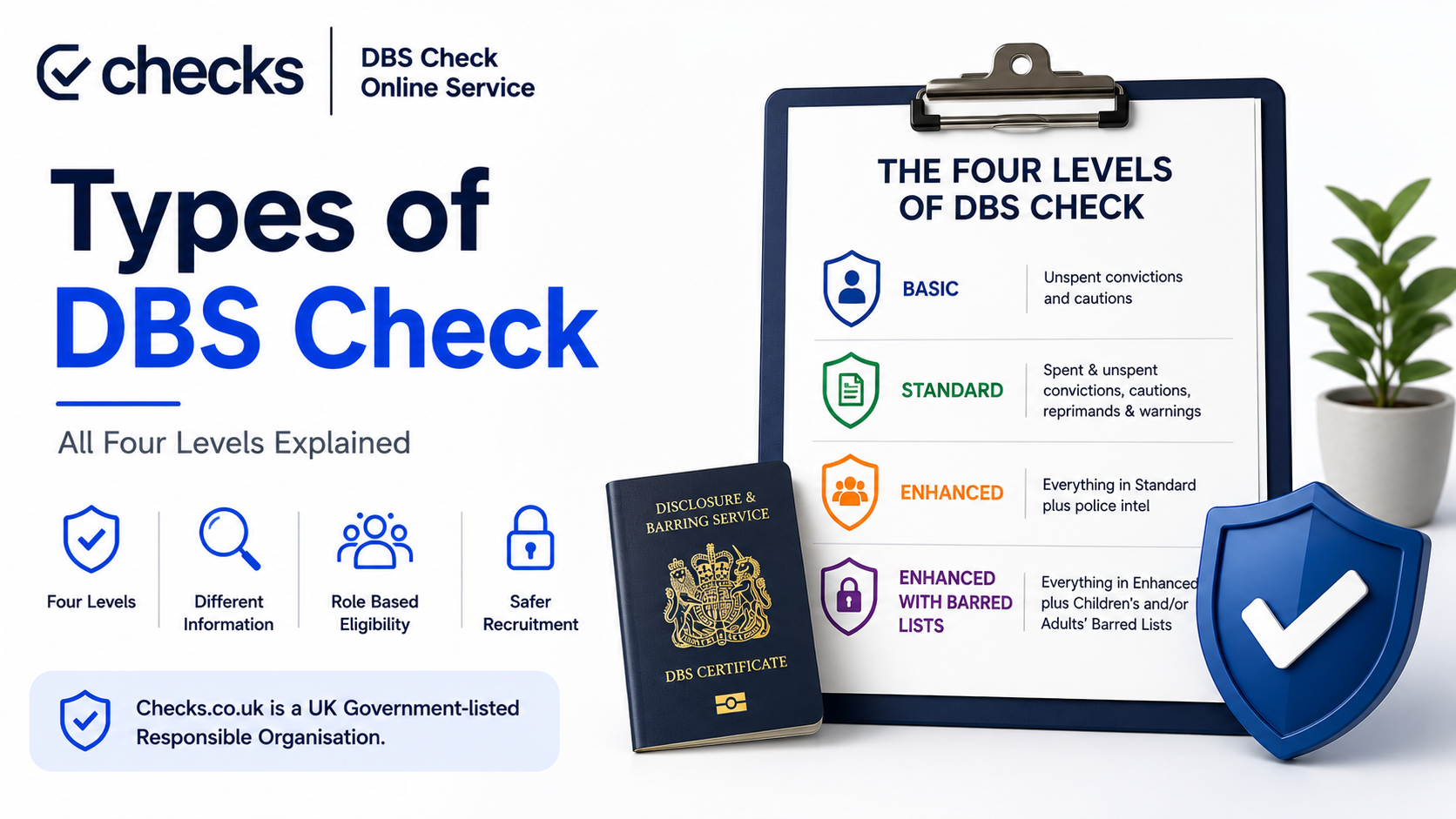
There are four types of DBS checks in England and Wales: Basic, Standard, Enhanced, and Enhanced with Barred Lists. Each one discloses progressively more information and carries different eligibility requirements depending on the role. In 2024-25, the Disclosure and Barring Service issued 7,272,217 certificates across all four check levels (DBS Annual Report 2024-25, GOV.UK).
Checks.co.uk is a UK Government-listed Responsible Organisation, authorised to process all four DBS check levels on behalf of employers and individuals.
There Are Four Types of DBS checks, Not Three
A significant number of sources currently ranking for this topic list only three DBS check levels and leave out the Enhanced DBS Check with Barred Lists (GOV.UK, DBS check types). This matters because employers and HR teams who act on that incomplete guidance can make safeguarding errors. The barred list check is not an optional add-on to the Enhanced check. It is a separate legal requirement for certain roles, and treating the two as one risks placing a barred person in a role they are prohibited from holding.
The Enhanced DBS Check with Barred Lists is a legally distinct level, not a variant of the plain Enhanced check. For roles involving regulated activity with children or vulnerable adults, it is mandatory. The four-level structure below sets out exactly where it sits. If you are new to the subject, our guide on what a DBS check is gives the full background.
The Four DBS Check Levels at a Glance
The table below compares all four DBS check levels by what each discloses, who can apply, the current government fee, and typical use.
| Check Level | What It Discloses | Who Can Apply | Government Fee | Typical Use |
|---|---|---|---|---|
| Basic | Unspent convictions and conditional cautions | Anyone | £21.50 | General employment |
| Standard | Spent and unspent convictions, cautions, reprimands, and warnings | Employer or Responsible Organisation (eligible roles only) | £21.50 | Licensed and trust roles |
| Enhanced | Everything in Standard, plus locally held police intelligence | Employer, Responsible Organisation, or self-employed via a registered platform (from January 2026) | £49.50 | Safeguarding roles |
| Enhanced with Barred Lists | Everything in Enhanced, plus a search of the Children’s and/or Adults’ Barred Lists | Employer or Responsible Organisation (regulated activity roles only) | £49.50 | Regulated activity roles |
Government fees current from 2 December 2024 (GOV.UK).
Basic DBS Check
The Basic DBS check is the entry-level criminal record check, available to any individual or employer without eligibility restrictions. Full details are on the Basic DBS Check page.
What a Basic DBS Check Discloses
Only unspent convictions and conditional cautions held on the Police National Computer are disclosed, as defined under the Rehabilitation of Offenders Act 1974. Spent convictions, locally held police intelligence, and barred list information do not appear. The reason spent convictions are excluded comes down to filtering, explained in our guide on what a DBS check shows.
Who Can Apply for a Basic DBS Check
Any individual can apply for a Basic DBS check for themselves, and any employer can request one for any role. There is no eligibility requirement linked to the type of work involved, making it the only DBS check level with no role restriction.
Typical Roles That Use a Basic DBS Check
Employers tend to choose a Basic DBS check where they want assurance about unspent convictions but the role does not meet the eligibility threshold for a Standard or Enhanced check. Common examples include:
- general employment and office-based roles,
- retail and hospitality positions,
- administration and clerical roles,
- letting agents and estate agency staff,
- delivery drivers and courier roles,
- IT contractors and freelance technicians,
- self-employed tradespeople, and
- domestic cleaners and household staff.
Standard DBS Check
A fuller criminal record history is disclosed at this level than on a Basic check, and the Standard check is restricted to eligible roles only. Full details are on the Standard DBS Check page.
What a Standard DBS Check Discloses
Both spent and unspent convictions, cautions, reprimands, and final warnings held on the Police National Computer are disclosed, subject to DBS filtering rules.
Reprimands and final warnings are legacy youth disposals that are no longer issued, but they can still appear where they remain on a person’s record. Locally held police intelligence and barred list information are not included.
Filtering rules may remove certain old or minor offences from the certificate, which means not every conviction on the Police National Computer will necessarily appear. Our guide on spent and unspent convictions explains how filtering works in more detail.
Who Can Apply for a Standard DBS Check
Only an employer or a Responsible Organisation can request a Standard DBS check, and the individual cannot apply for themselves.
The application must be countersigned before submission to the DBS. The role must also be legally eligible under the Rehabilitation of Offenders Act 1974 (Exceptions) Order 1975 for a Standard check to be requested at all.
Typical Roles That Require a Standard DBS Check
The following roles may require a Standard DBS check, subject to the employer confirming the role meets the legal eligibility threshold:
- solicitors and legal professionals,
- accountants and financial advisers,
- security industry workers holding an SIA licence,
- certain NHS roles not involving regulated activity,
- pharmacists in non-regulated activity roles,
- insurance brokers, and
- some local authority and public sector roles.
Enhanced DBS Check
The Enhanced DBS check is the most comprehensive level available for safeguarding roles and carries different eligibility requirements from the Standard check. Full details are on the Enhanced DBS Check page.
What an Enhanced DBS Check Discloses
Everything included in a Standard check is disclosed, plus any locally held police intelligence that the chief police officer of a relevant force considers relevant to the role, under Part V of the Police Act 1997.
This locally held intelligence does not appear on Basic or Standard certificates and is unique to the Enhanced level.
Whether additional police information is returned is at the discretion of the chief officer, so not every Enhanced certificate returns intelligence beyond the Police National Computer, but the check is conducted regardless.
Does an Enhanced DBS Check Automatically Include a Barred List Search?
No. An Enhanced DBS check and an Enhanced DBS check with Barred Lists are two legally distinct check levels.
A plain Enhanced check does not include a barred list search unless one is specifically requested, and the search is only added when the role involves regulated activity as defined under the Safeguarding Vulnerable Groups Act 2006.
Employers must confirm whether the role involves regulated activity before deciding which of these two levels to request.
Who Can Apply for an Enhanced DBS Check
An employer or Responsible Organisation must submit the application, and the individual cannot apply for themselves. The application requires countersignature before submission to the DBS.
From 21 January 2026, self-employed individuals working in regulated activity with children or vulnerable adults can apply for an Enhanced DBS check independently through a registered platform acting as the countersigning organisation.
Our guide on getting an Enhanced DBS check for yourself explains how this works.
Typical Roles That Require an Enhanced DBS Check
The following roles typically require an Enhanced DBS check. Whether a barred list search is also needed depends on whether the specific role involves regulated activity, which is covered in the next section:
- teachers and teaching assistants,
- NHS clinical staff in patient-facing roles,
- social workers,
- childcare practitioners and nursery staff,
- GPs and hospital doctors,
- sports coaches working with children,
- taxi and private hire drivers (council licensing requirement),
- school governors,
- religious leaders working in regulated activity, and
- SIA workers in roles involving regulated activity with vulnerable people (a higher requirement than the Standard SIA roles listed above).
Enhanced DBS Check with Barred Lists
This is a legally distinct fourth check level with its own specific eligibility requirements, not a variant of the plain Enhanced check.
What the Barred List Search Adds
A search of the Children’s Barred List, the Adults’ Barred List, or both is added at this level. These lists are maintained by the DBS and contain individuals who are legally prohibited from working in regulated activity.
The search is conducted alongside the standard Enhanced check process and does not extend processing time significantly in most cases.
As of March 2025, 91,015 people were on the Children’s Barred List and 69,900 were on the Adults’ Barred List (DBS Annual Report 2024-25, GOV.UK). The government fee is £49.50, the same as a plain Enhanced check, because the barred list search carries no additional DBS charge.
When Is a Barred List Search Mandatory?
A barred list search is mandatory when a role involves regulated activity as defined by the Safeguarding Vulnerable Groups Act 2006.
Engaging a barred person in a regulated activity is a criminal offence for both the individual and the organisation that knowingly employs them.
For roles that involve regulated activity, requesting an Enhanced DBS Check with Barred Lists is not optional.
What Happens If the Wrong Type of DBS Check Is Requested?
Requesting the wrong level of DBS check has different legal consequences depending on which error is made (DBS eligibility guidance; Safeguarding Vulnerable Groups Act 2006):
- A Basic check is requested when Standard or Enhanced is required. The employer has not met their legal safeguarding duty. The certificate returned will not disclose the information the role requires, and the employer cannot rely on it as evidence of a sufficient check.
- A Standard or Enhanced check is requested for a role that does not meet the eligibility threshold. The application may be rejected by the DBS. Requesting a higher level of check than the role legally permits is not compliant, regardless of intent.
- A barred list search is omitted for a role involving regulated activity. The employer is in breach of their safeguarding obligations and may be exposed to criminal liability under the Safeguarding Vulnerable Groups Act 2006 if a barred person is subsequently engaged in regulated activity.
Which Type of DBS Check Do You Need?
The correct check level depends on the role, not on preference, and three factors determine it: what information the role legally permits the employer to request, whether the role involves regulated activity, and whether the applicant is employed or self-employed.
Getting the level wrong can result in a rejected application, an incomplete safeguarding check, or a legal compliance failure.
For a full breakdown of which check applies to your role, see the which DBS check do I need guide or use the type of service tool.
Apply for the Right DBS Check Through Checks.co.uk
Checks.co.uk is a UK Government-listed Responsible Organisation, registered in England and Wales under company number 15076484 and registered with the Information Commissioner’s Office under reference XB691512, authorised to process all four DBS check levels on behalf of employers and individuals.
Frequently Asked Questions About Types of DBS Check
How many types of DBS check are there?
There are four types of DBS check in England and Wales: Basic, Standard, Enhanced, and Enhanced with Barred Lists. Some sources state there are three types, which omits the Enhanced with Barred Lists check. This is a legally distinct fourth level used for roles involving regulated activity with children or vulnerable adults, and it is mandatory for those roles.
What is the difference between a Standard and an Enhanced DBS check?
A Standard DBS check shows spent and unspent convictions, cautions, reprimands, and final warnings held on the Police National Computer. An Enhanced DBS check includes everything in a Standard check plus any locally held police intelligence the chief officer considers relevant to the role. Enhanced checks can also include a barred list search where the role involves regulated activity, which Standard checks cannot.
Can an employee apply for their own DBS check?
It depends on the check level. Any individual can apply for their own Basic DBS check. Standard and Enhanced checks can only be requested by an employer or Responsible Organisation because the application requires countersignature. From 21 January 2026, self-employed individuals in regulated activity roles can apply for an Enhanced DBS check independently through a registered platform that acts as the countersigning organisation.
What type of DBS check do teachers need?
Teachers and teaching assistants working in schools typically require an Enhanced DBS check with Barred Lists, as their roles involve regulated activity with children. School governors and volunteers in regulated activity also require an Enhanced check, usually with a barred list search. The exact requirements follow Keeping Children Safe in Education 2025 guidance and are confirmed by the school as the employing organisation.
What is the cost of each type of DBS check in 2026?
A Basic or Standard DBS check costs £21.50. An Enhanced DBS check costs £49.50, and the same fee applies to an Enhanced DBS check with Barred Lists, as the barred list search carries no additional DBS charge. These fees have applied since 2 December 2024. Processing organisations may charge a separate administration fee on top of the government fee.
What type of DBS check is needed for working with vulnerable adults?
Roles involving regulated activity with vulnerable adults typically require an Enhanced DBS check with an Adults’ Barred List search. Regulated activity with adults covers providing personal care, healthcare, or social work on a regular, unsupervised basis. If the role is supervised or does not meet the definition of regulated activity, a plain Enhanced check may be sufficient. The employing organisation is responsible for determining the correct check level.