- There Is No Such Thing as Renewing a DBS Certificate: What You Actually Need to Do
- Route 1: Renewing Your DBS Update Service Subscription
- Route 2: Applying for a Brand New DBS Check
- How Often Should a DBS Check Be Renewed?
- Can I Renew My DBS Check Before It Expires?
- Apply for a New DBS Check Through Checks.co.uk
- Frequently Asked Questions About DBS Renewal
How to Renew a DBS Check: Complete Renewal Guide for England and Wales
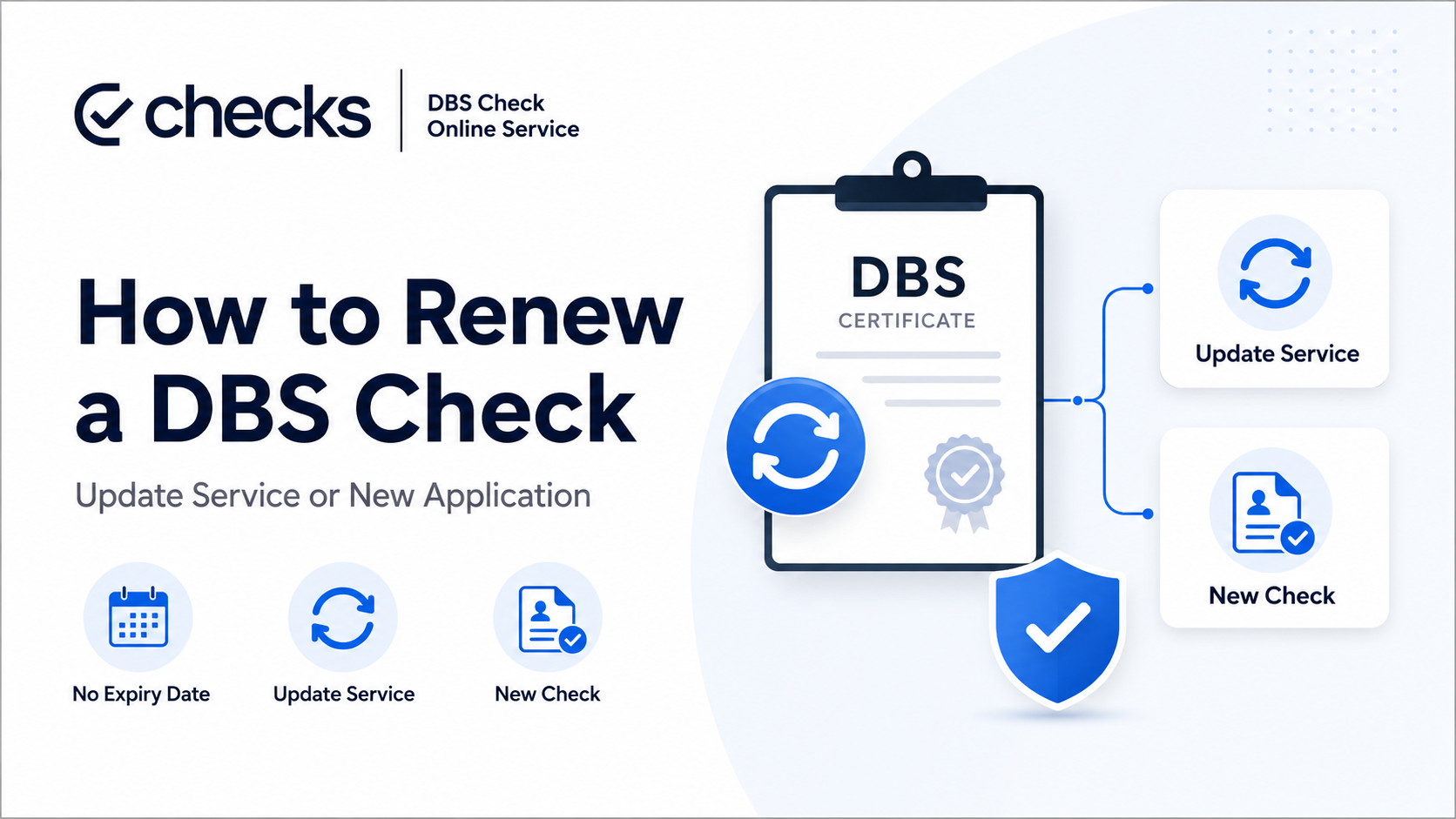
What most people call ‘renewing a DBS check’ is one of two separate processes: renewing a DBS Update Service annual subscription, or applying for a brand new DBS check from scratch. A DBS certificate has no official expiry date and cannot be renewed in the traditional sense. Which route applies depends entirely on whether the individual is currently subscribed to the DBS Update Service.
Checks.co.uk is a UK Government-listed Responsible Organisation, authorised to process DBS applications across all check levels.
There Is No Such Thing as Renewing a DBS Certificate: What You Actually Need to Do
A DBS certificate has no official expiry date and cannot be renewed, reissued, or extended (gov.uk DBS guidance). The word ‘renewal’ as used by employers, sectors, and applicants refers to one of two separate processes.
The first is renewing the DBS Update Service annual subscription, which keeps an existing Standard or Enhanced certificate portable and live.
The second is applying for a brand new DBS check, which is identical in every way to the original application process. The correct route depends entirely on whether the individual is subscribed to the DBS Update Service and whether that subscription is still active.
Route 1: Renewing Your DBS Update Service Subscription
For individuals already subscribed to the DBS Update Service, ‘renewal’ means renewing the annual subscription before it expires.
See our guide on the DBS Update Service for full background on how the service works. Those not on the service must apply fresh, which is covered in Route 2 below.
How to Renew Your Subscription Online Before It Expires
Log in to your DBS Update Service account at gov.uk/dbs-update-service and make a card payment. The subscription must be renewed within the 30-day window before the expiry date.
The DBS sends an email reminder 30 days before expiry from donotreply@dbs.gov.uk, followed by a letter 14 days before. The renewal must be completed the day before the expiry date at the latest: the account is closed on the day it expires and cannot be renewed on that date.
The cost is £16 by debit or credit card. Direct Debit is not available. Eligible volunteers pay no fee (gov.uk DBS Update Service applicant guide, updated 15 May 2025).
How Automatic Renewal Now Works: The Process Changed in 2024
Most competitor articles describe the DBS Update Service renewal as fully automatic. This is no longer accurate. The DBS changed its renewal process in late 2024. Previously, subscriptions renewed automatically with no action required from the subscriber.
Now, the DBS sends an email requiring the subscriber to click a link and actively complete a short form, including confirming their name and DBS certificate number, within 14 calendar days.
If the form is not completed within that window, the subscription expires. Applicants who set up auto-renewal are not exempt from this requirement. The email is sent by the DBS, not by the employer or the Responsible Organisation.
The Card Expiry Warning: When Auto-Renewal Can Silently Fail
If the DBS Update Service is set to auto-renewal, the DBS attempts to charge the card stored on the account. If that card has expired or the details have changed, the payment fails and the subscription lapses permanently.
The certificate is then removed from the service and cannot be re-added. This is a specific risk for individuals who set up the subscription with a card that has since expired, used someone else’s card that has since expired, or changed their bank account (gov.uk DBS Update Service guide; Wirral Council DBS guidance).
To prevent this, update card details on the DBS Update Service account before the stored card expires. Remember that DBS does not support Direct Debit, so card details must be kept current manually.
What Happens If Your Subscription Lapses Before You Renew
If the DBS Update Service subscription expires without being renewed, the DBS certificate is permanently removed from the service. It cannot be re-added under any circumstances, not even if only one day has passed.
The only option is to apply for a brand new DBS check from scratch under Route 2 below, and to register the new certificate on the Update Service within 30 days of its issue date.
This applies to Standard and Enhanced certificates: Basic checks cannot be added to the Update Service at all.
Route 2: Applying for a Brand New DBS Check
For individuals who are not subscribed to the Update Service, whose subscription has lapsed, or whose employer requires a fresh certificate, the process is a completely new DBS application.
There is no special renewal form. The process is identical to the original application.
When a Completely New Application Is Required
A new DBS application is necessary in four situations:
- The individual is not subscribed to the DBS Update Service.
- The subscription has lapsed and the certificate was permanently removed.
- The employer’s policy requires a fresh certificate regardless of Update Service status.
- The role has changed to one requiring a different check level or workforce.
In all four cases, the process is the same as any new DBS application. No special renewal route exists.
See our guide on the types of DBS check to confirm the correct level for the new application.
How Long Does a New DBS Application Take?
The processing time for a new application is the same as for any DBS check. Basic and Standard checks typically return within 24 hours to 7 working days.
Enhanced checks take an average of 22 days nationally as of March 2026, and can take up to 60 days or more where delays occur.
The application is processed at the same speed whether it is a first-time or repeat check. See our guide on how long a DBS check takes for more detail.
How Much Does a New DBS Check Cost?
Government fees from 2 December 2024: Basic DBS check £21.50, Standard DBS check £21.50, Enhanced DBS check £49.50, Enhanced with Barred Lists £49.50 (gov.uk DBS fee guidance, updated 2 December 2024).
These are the same fees as any original DBS application. There is no reduced or separate renewal fee. A Responsible Organisation or umbrella body may also charge an administration fee on top of the government fee.
Volunteers applying for Standard or Enhanced checks pay no government fee.
Joining the Update Service After Your New Application
When a new DBS application is submitted, the applicant has 28 days from the application submission, using the form reference number, or 30 days from the certificate issue date, using the certificate number, to join the DBS Update Service (gov.uk DBS Update Service applicant guide).
Not joining the Update Service when receiving a new certificate creates the same situation that required the new application in the first place.
Joining immediately after receiving the certificate removes the need for a further full application in future, provided the subscription is kept active. See our guide on what the DBS Update Service is for full details.
How Often Should a DBS Check Be Renewed?
No law specifies how frequently DBS checks must be renewed. Renewal frequency is set by the employer, the sector regulator, or organisational policy.
The guidance below reflects standard practice in each sector, not statutory requirements.
Schools and Ofsted-Regulated Settings
Schools and early years settings follow Keeping Children Safe in Education 2025 (KCSIE 2025), which requires up-to-date safeguarding records but does not specify a renewal frequency (DfE, KCSIE 2025; Ofsted safeguarding requirements).
Most Ofsted-registered settings renew Enhanced DBS checks every one to three years as a matter of policy. Where the DBS Update Service is in use, many schools carry out an annual status check instead of requesting a new certificate.
How often checks are renewed in schools specifically depends on the school’s own safeguarding policy.
Healthcare and NHS
NHS trusts typically require DBS checks to be renewed every three years under NHS Employment Check Standards. NHS Professionals and similar staffing organisations may have their own renewal timelines.
Where staff are registered with the DBS Update Service, employers can conduct a status check annually rather than requesting a new certificate each cycle.
Social Care and CQC-Regulated Providers
CQC-regulated adult social care providers are expected to maintain appropriate and proportionate DBS checking policies (CQC Fundamental Standards).
Most CQC-registered providers renew Enhanced DBS checks every one to two years. For staff in high-risk roles with vulnerable adults, some providers renew annually.
The DBS Update Service significantly reduces administrative burden in these settings.
Security Industry and Taxi/Private Hire Drivers
Security industry workers with SIA licences must renew their licence every three years, and a new Standard DBS check is required as part of the SIA licence renewal process (SIA licensing requirements).
Taxi and private hire drivers must maintain a current Enhanced DBS certificate throughout the life of their licence under council licensing conditions.
Some councils now require drivers to maintain continuous DBS Update Service registration, removing the need for periodic new applications.
Can I Renew My DBS Check Before It Expires?
Yes, in both scenarios. For the DBS Update Service subscription, the renewal window opens 30 days before the expiry date, and renewing early is strongly recommended rather than waiting until the deadline.
For a new DBS check application, a new check can be applied for at any time.
Employers may request a new check whenever their policy requires it, and individuals can apply for a new Basic DBS check independently whenever they choose.
Apply for a New DBS Check Through Checks.co.uk
Checks.co.uk is a UK Government-listed Responsible Organisation, registered in England and Wales (Company Number 15076484) and registered with the Information Commissioner’s Office (ICO Reference XB691512).
All applications are submitted to the DBS immediately, which helps minimise avoidable delays.
Frequently Asked Questions About DBS Renewal
How do I renew my DBS check?
Renewing a DBS check means one of two things. If you are subscribed to the DBS Update Service, log in to your account at gov.uk/dbs-update-service and renew the annual subscription before it expires. The cost is £16 by card. If you are not subscribed, you must apply for a brand new DBS check through a Responsible Organisation or directly at gov.uk for a Basic check. There is no separate renewal form. The process is the same as the original application.
Does the DBS Update Service renew automatically?
Not fully. The DBS changed its renewal process in late 2024. Previously, subscriptions renewed automatically without any action required. Now, the DBS sends an email to the subscriber requiring them to actively click a link and complete a short form within 14 calendar days. If you do not respond within that window, your subscription expires. You should also ensure the card stored on your account has not expired, as a failed payment causes permanent lapse.
How often does a DBS check need to be renewed?
There is no legal renewal frequency for DBS checks. DBS certificates have no official expiry date. Employers and sector regulators set their own renewal policies. Most organisations in education, healthcare, and social care renew Enhanced DBS checks every one to three years. The DBS Update Service, which costs £16 per year, allows employers to conduct an annual online status check instead of requesting a new certificate each cycle.
What happens if I do not renew my DBS Update Service subscription in time?
If your DBS Update Service subscription expires without being renewed, your DBS certificate is permanently removed from the service and cannot be re-added. You must apply for a brand new DBS check and register the new certificate on the Update Service within 30 days of issue. This applies even if only one day has passed since the subscription expired. There is no reinstatement process.
Can I renew my DBS check before it expires?
If you are on the DBS Update Service, yes. You can renew your subscription up to 30 days before it expires and it is recommended to do so early. If you need a new DBS certificate rather than a subscription renewal, you can apply for one at any time. Employers can request a new DBS check whenever their policy requires it. There is no minimum period you must wait between DBS applications.
How much does it cost to renew a DBS check?
If you are renewing a DBS Update Service subscription, the cost is £16 per year (free for eligible volunteers). If you need a brand new DBS check, the government fee is £21.50 for a Basic or Standard check and £49.50 for an Enhanced check, as confirmed in the December 2024 fee update. A Responsible Organisation may also charge an administration fee on top of the government fee. These fees are the same whether the check is a first-time application or a repeat.
Can my employer make me pay for my own DBS renewal?
There is no law that requires an employer to pay for a DBS check. For Basic DBS checks applied for independently, individuals pay the fee themselves. For Standard and Enhanced checks requested by an employer, most employers cover the cost, but they are not legally obliged to do so. Whether the employer or employee pays is a matter of employment contract and policy. Volunteers qualifying for a Standard or Enhanced check pay no DBS fee and the employer cannot charge them the government fee.